An out-of-body induction ritual.
Twelve guided protocols, built around the oldest map of the threshold: let the body fall asleep while the mind stays awake, widen awareness past the edge of the body, rest where time stops, and come back. Voice, landscape and a binaural field that changes with every stage carry you there. Experience markers record what happens while it happens. The Live EEG edition records what your brain was doing at the same moment.
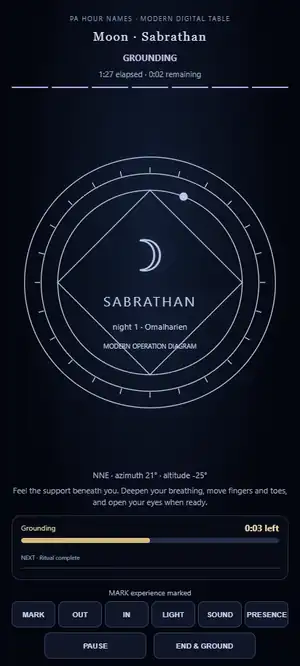
An out-of-body experience is the vivid sense of perceiving the world from a location outside your own physical body. People who report one describe a recognisable run of events: a heaviness as the body goes still, a buzzing or rushing “vibration” spreading through it, sometimes a roar or a high ringing, then a sensation of rising, rolling or floating free, and a view of the room, or of their own body, from somewhere it cannot be seen from. The return is often abrupt, with a jolt and a rush of ordinary bodily feeling.
The experience is far from rare, and it has been mapped many times: by Robert Monroe’s graded Focus states, by the hypnagogic literature on the edge of sleep, by the yordei merkavah who “descended to the Chariot” with head between the knees, by the vǫlva on her high seat while the varðlokkur were sung. The research behind OBE Induction is on its own page.
OBE Induction follows the ritual logic those traditions share. It does not play you a recording and hope. It prepares you, orders the stages, holds you at the edge, and brings you back.
Every session follows the same six-part arc. The protocols change what happens inside it.
A human voice carries the phases, attunement, purification, deepening, induction, integration, and adaptive cues: remain still, soften the body, release the location, let awareness expand. Orientation prompts guide you to turn, raise or lower the phone until you are aligned.
Night forest, river, rain, wind, thunder and dawn birds crossfade from stage to stage beneath dedicated Focus drones, a tribal theta drum and crystal bowl, each set to its own level for each stage.
Each stage has its own carrier tone and its own beat between the ears, changing gradually rather than switching, so the brain is led from one rhythm to the next. Every layer is generated on the device in real time.
The central protocol walks the published sequence of Focus states. In Focus 10 the body goes heavy and quiet while awareness stays clear. In Focus 12 awareness widens beyond the boundary of the skin until the room itself is part of what you are calmly observing. In Focus 15 you stop measuring time and rest in still, continuous awareness, the stage the guidance describes as “stop seeking an event.” Then a full sensory Return.
The beat drops as you go deeper, from the alpha border into the heart of theta, then climbs back for the return. The carrier tone moves with it, so each state has its own unmistakable sonic signature that you learn to recognise and, with practice, re-enter.
An independent, original audio design inspired by published descriptions of the Focus levels. Not affiliated with the Monroe Institute; contains no Monroe recordings.
Each protocol has its own stages, carrier, beat arc and landscape, and its own source note explaining exactly what it draws on and what it does not claim.
The Ars Paulina, third book of the Lemegeton, gives a ruling angel to each of the twenty-four hours. Those hours are not clock hours. They are unequal “temporal” hours: daylight divided into twelve, night divided into twelve, so they stretch and shrink with the seasons and with where you stand.
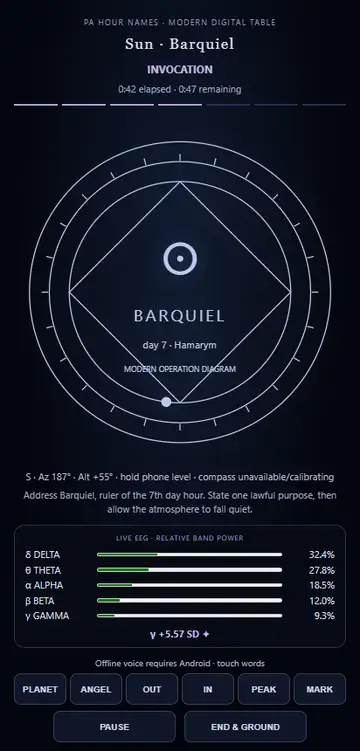
OBE Induction computes them properly. With your permission it reads your location, calculates the true local sunrise and sunset, finds the current temporal hour and its planet in the traditional sequence, and names the angel of that hour from the Sloane manuscript table. A seal diagram turns at the centre of the screen. In the Celestial Alignment stage the compass guides you to face the azimuth of the ruling planet, even when it is below the horizon, with eyes lowered if it is the Sun.
The ceremony then runs in seven stages: purification, celestial alignment, planetary attunement, invocation, quiet audience, thanksgiving and license to depart, and grounding. The sound field darkens and quiets as you approach the audience, then opens again for the return. The voice warns you when the hour is about to change.
Memory edits experience within minutes. So the app lets you log events at the moment they occur, with a tap or, on Android, a spoken word, without opening your eyes or breaking the state.
The moment of separation: rising, rolling, stepping out.
The return to the body. OUT and IN are paired into a timed transition.
Luminous fields, points or figures.
Vibration, roar, ringing, voices or tones not in the audio.
The sense that someone or something is near.
Anything else worth finding again later.
In the EEG edition: moments of attunement during the ceremonial hours.
In the EEG edition: the high point of the session.

OBE Induction has an EEG counterpart, Ritual: the same twelve protocols, voice and landscapes, rebuilt around a live brain signal. It connects to a Neurosity Crown and streams relative band power, delta, theta, alpha, beta and gamma, through the whole session. Everything you mark is stamped with the state of your brain at that instant.
At the end of a session Ritual writes an Excel workbook. It holds two kinds of record side by side and never mixes them: what you experienced, in your own markers and words, and what the headset measured.
Focus progression, 30 minutes, lying down, eyes closed. An illustrative composite drawn from the kinds of sessions we log in our own practice; times and values are representative, not a transcript.
Reflection, in the practitioner’s words: what was felt, what was seen, what is uncertain, and one grounded action to carry forward.
OBE Induction on Google Play gives you all twelve protocols, the voice, the landscapes, the binaural field, the markers and your private practice history. Ritual, the Live EEG edition, adds the Neurosity Crown connection, a sound field shaped by your own brain, gamma harmonics on each sustained burst, and the full Excel session report.
Use OBE Induction seated or lying down, with headphones, never while driving or operating machinery. Stop if you feel light-headed or distressed. If you have epilepsy or a seizure disorder, or a history of dissociation or psychosis, consult a clinician before using rhythmic audio and deep-relaxation practices. OBE Induction is for contemplation, study and personal practice; it is not a medical device and does not diagnose or treat any condition. Neurosity and Crown are trademarks of their owner; Discovery Science is independent.
Sources, studies and the history of out-of-body research: Research · The Archive.